TL;DR — Best AI tools for data analysis & visualization in 2026
For large business datasets that need AI-led analysis, dashboards, and recurring reporting, start with Anomaly AI. For Microsoft-stack governed BI, use Power BI. For visual analytics, use Tableau. For custom ML on GCP, use Google Vertex AI. For regulated enterprise BI, use IBM Cognos with watsonx. For embedded analytics, use Sisense. For quick file chat, use Julius AI. For search-based enterprise analytics, use ThoughtSpot.
All eight compared below with live-verified 2026 pricing, agentic feature updates, and a decision framework by team size and skill level.
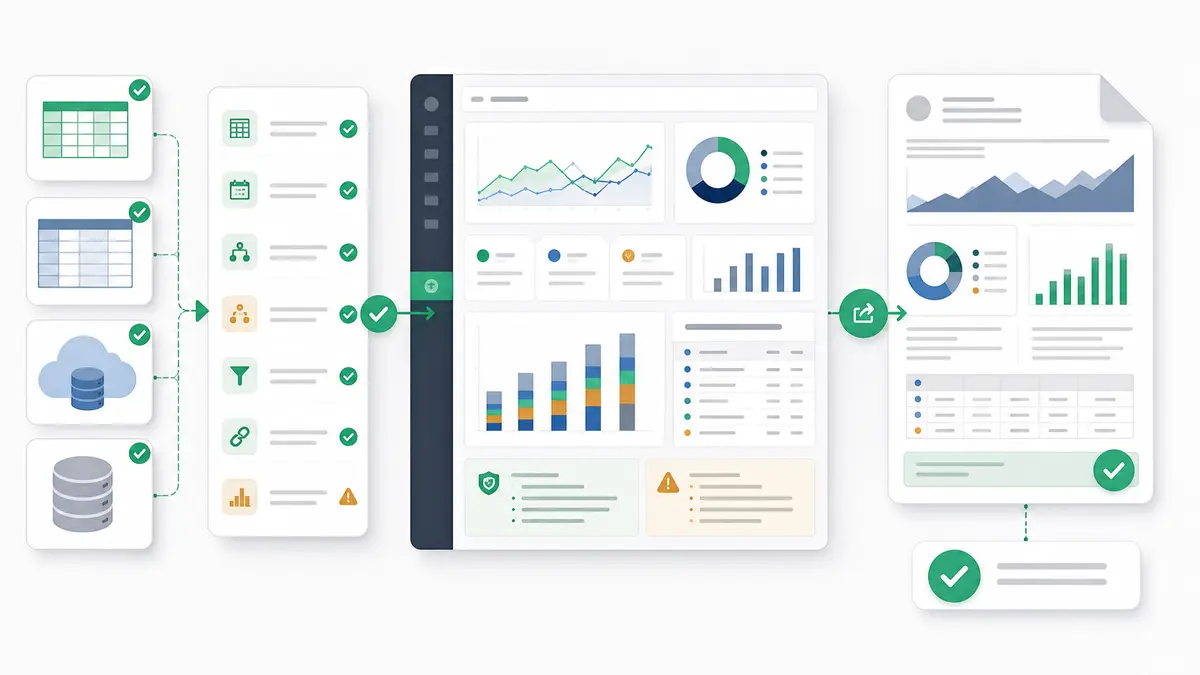
The shortlist for "best AI tools for data analysis 2026" and "best AI for data visualization" splits into three shapes. Dashboard-centric BI platforms (Tableau, Power BI, Sisense, ThoughtSpot, IBM Cognos) help teams model data and build governed views. AI analyst tools (Anomaly AI, Julius AI) run analysis from natural-language requests, but Anomaly goes further into dashboards and recurring reporting workflows. ML platforms (Vertex AI) sit alongside both for teams that need to train custom models rather than just analyze existing data.
This guide compares the eight tools we see most often in real evaluations, with pricing verified against the live vendor pricing pages on the publication date below, 2026 feature updates, and a decision framework that matches each platform to a concrete team profile.
What "AI data analysis" actually means in 2026
AI data analysis tools use large language models, machine learning, and natural language interfaces to translate questions about data into queries, surface patterns, and generate visualizations. The 2026 shift is from "AI suggests a chart" to "AI agent investigates proactively" — every major platform now ships an agent (Tableau Agent, Power BI Copilot, watsonx assistant, Sisense AI, ThoughtSpot Sage) that can build calculations, explore data, and answer follow-up questions conversationally.
Three properties separate platforms that hold up under real use from those that just demo well:
- Verifiability. Does the tool show the logic, source data, assumptions, and calculations behind the output? Black-box "insights" don't survive contact with finance, clients, or executives who need a defensible number.
- Connectors that match where your data actually lives. If your data is in BigQuery, Snowflake, GA4, MySQL, Excel, or Google Sheets, the tool needs first-party connectors for those — not "via API with custom integration."
- Scale safety. The point at which a tool degrades. Spreadsheets crawl past a few hundred thousand rows; Excel-tier tools choke at file size limits; some AI tools cap context at a fraction of a real dataset.
Key features to look for
Natural-language querying with follow-up handling — not just "show me revenue" but "now break that down by region, and only the regions that grew."
Automated data preparation — schema detection, type inference, handling missing values, joining sheets or tables without manual VLOOKUP or DAX gymnastics.
Agentic exploration — the system runs multi-step analyses on its own (look at the trend, segment by cohort, flag the anomaly) instead of waiting for the next prompt.
Traceability and data lineage — every dashboard, report, chart, or document links back to the logic and source rows, so an analyst can verify, modify, or export.
Real-time and scheduled refresh — answers and dashboards update as the underlying data changes, with alerts on metric movement.
Enterprise integration — connectors for warehouses (BigQuery, Snowflake), spreadsheets (Excel, Google Sheets), and analytics platforms (GA4), plus SSO and role-based access for governed deployments.
Comparison table — 8 AI tools for data analysis & visualization in 2026
At-a-glance comparison. Pricing reflects publicly listed plans verified against the vendor pricing page on the publication date below; enterprise tiers typically require a sales conversation and the figures shown are starting prices.
| Tool |
Best For |
Starting Price |
Key 2026 Feature |
Verdict |
| Anomaly AI |
Large datasets, spreadsheets, and business reporting |
Free $0; Starter $16/month, Pro $25/month, Team $45/seat/month |
AI-led analysis, dashboards, and recurring reporting workflows |
Best when your data has outgrown spreadsheets and you need the AI to do the analysis work |
| Tableau (with Tableau Agent) |
Visual analytics and storytelling at enterprise scale |
Tableau Cloud Standard $15/user/month (billed annually) |
Tableau Agent (in Tableau+ Bundle) builds calculations, explains outliers, and answers follow-ups conversationally |
Strongest fit when visualization quality and executive storytelling matter most |
| Microsoft Power BI (with Copilot) |
Governed BI inside the Microsoft / Fabric ecosystem |
Power BI Desktop free; Pro $14/user/month (paid yearly); Premium Per User $24/user/month |
Copilot in Power BI for natural-language report generation and DAX authoring; native Microsoft Fabric lakehouse integration |
The default for Microsoft-shop enterprises that need governed BI with AI assistance |
| Google Vertex AI |
Custom ML models on Google Cloud without a dedicated data-science team |
Pay-as-you-go (consumption-based) |
Gemini integration for generative AI inside Vertex AI Workbench; AutoML for forecasting, classification, and image / text models |
Best for GCP-committed teams that need to train custom models, not just analyze data |
| IBM Cognos Analytics (with watsonx) |
Enterprise BI for regulated and global organizations |
Custom enterprise pricing |
watsonx AI assistant for conversational analytics powered by IBM's foundation models |
Best in regulated industries that need industry-specific templates and global compliance |
| Sisense |
Embedded analytics inside SaaS products and white-label deployments |
Custom enterprise pricing |
Sisense AI for natural-language queries, ML forecasting, and Pulse alerts on metric changes |
Best when analytics has to live inside a product the customer already uses |
| Julius AI |
Chat-first data agent for ad-hoc analysis on uploaded files |
Free; Plus $16/month (billed annually); Pro $37/month; Business $375/month |
Notebooks, Slack agent, and Snowflake / BigQuery / Postgres connectors on Business tier |
Best for quick exploratory analysis on CSV / Excel uploads when you don't want to set up a connector-based platform |
| ThoughtSpot (with Sage) |
Search-based self-service analytics at enterprise scale |
Enterprise pricing (contact sales) |
ThoughtSpot Sage layers generative AI on top of SpotIQ automated insights and the search-first interface |
Best for enterprises with a clean governed data model that want a search-first experience for thousands of users |
Pricing verified against vendor pricing pages on the date shown in the article header. Enterprise tiers and Tableau+ Bundle (which includes Tableau Agent on Cloud) require a direct sales conversation; figures here are starting prices for the lowest tier of each named plan.
1. Anomaly AI — Best for agentic AI analysis of large datasets & spreadsheets
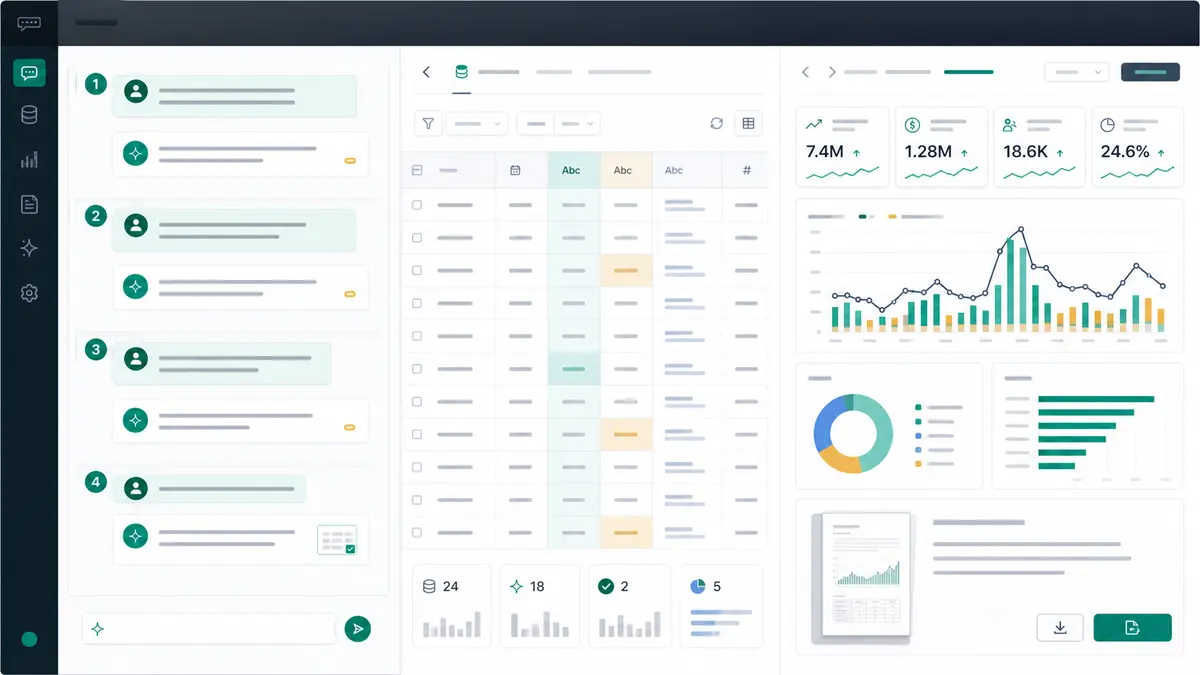
Anomaly AI is built for the gap between spreadsheets and full BI infrastructure. Ask for a dashboard, Excel report, scheduled report, or alert, and Anomaly turns the request into a shareable analysis asset.
Key capabilities:
- Plain-English reporting requests with multi-step follow-ups: "Build a weekly paid-channel dashboard and compare it to last month."
- Deeper analysis from plain English — ask for drivers, segments, changes, outliers, and follow-up cuts without writing SQL
- Cross-source joins across BigQuery, MySQL, GA4, ad account exports, Google Sheets, and Excel in a single workflow
- Large file handling — Excel and CSV files up to 1GB that break the row ceiling of spreadsheets
- Verifiable logic — inspect the source data, assumptions, calculations, and generated SQL when needed
- Stakeholder-ready reporting — dashboards, refreshable reports, and source-backed summaries generated from business data
Best for: Teams — marketers, finance operators, founders, product analysts, and consultants — who want the AI to do the analyst work: inspect messy data, find what matters, build useful outputs, and keep recurring reporting moving without learning SQL or standing up a BI project.
Pricing: Free $0 / Starter $16/month / Pro $25/month / Team $45/seat/month. Free tier has no credit card requirement. Get started
2. Tableau (with Tableau Agent) — Best for visual analytics
Tableau remains the leading enterprise visualization platform. In 2026, Tableau Agent — Salesforce's agentic AI layer that replaces the earlier Einstein AI branding — builds visualizations, explains outliers, and answers follow-up questions conversationally. Tableau Pulse delivers personalized, AI-driven metric monitoring proactively to stakeholders.
Key capabilities:
- Tableau Agent autonomously explores data, builds calculations, and suggests visualizations
- Tableau Pulse for personalized metric monitoring, delivered to stakeholders without manual report distribution
- Ask Data for natural-language question entry across web authoring
- Einstein Discovery for predictive analytics with "why" explanations
- Extensive connector library for cloud and on-premises sources
- Handles billions of records on Tableau Cloud or Tableau Server
Best for: Large organizations that need polished, governed visual analytics, Salesforce ecosystem users wanting tight CRM-to-analytics integration, and teams where visualization quality and executive storytelling are the top priorities.
Pricing (verified live): Tableau Cloud is sold by edition, billed annually. Tableau Standard starts at $15/user/month and includes web authoring, Tableau Desktop, Prep Builder, and Tableau Pulse. Tableau Enterprise starts at $35/user/month and adds Advanced Management and Data Management. Tableau+ Bundle, which includes Tableau Agent on Cloud and Tableau Next, is contact-sales. Every deployment requires at least one Creator-class license. Tableau Desktop has a free download for individual authoring.
3. Microsoft Power BI (with Copilot) — Best for the Microsoft ecosystem
Microsoft Power BI is the default BI for organizations already invested in Microsoft 365, Azure, or Fabric. Copilot in Power BI is generally available — it generates DAX, builds report pages from natural-language prompts, and summarizes dashboard insights conversationally. Power BI now lives inside Microsoft Fabric, Microsoft's unified analytics platform that brings the lakehouse, data engineering, and BI under one workspace.
Key capabilities:
- Copilot in Power BI for natural-language report generation, DAX authoring, and conversational summaries
- Microsoft Fabric integration — unified lakehouse, data engineering, and BI in one platform
- Decomposition Tree visual uses AI to identify root causes of metric changes
- Key Influencers automatically identifies factors significantly impacting metrics
- Q&A for natural-language questions with instant visual responses
- Native integration with Excel, Azure SQL, Dynamics 365, and Azure Machine Learning
- AI Insights apply pre-built ML models for sentiment, key phrase, and anomaly detection
Best for: Microsoft-shop enterprises seeking governed BI with AI assistance, organizations standardizing on Fabric, and teams that need extensive cloud and on-premises connectors with predictable per-seat pricing.
Pricing (verified live): Power BI Desktop is a free download. Microsoft Fabric Free account includes Power BI item consumption for Fabric capacity SKUs F64 and above. Power BI Pro is $14/user/month, paid yearly. Power BI Premium Per User is $24/user/month, paid yearly. Fabric capacity tiers add additional cost for organizations consolidating BI with data engineering.
4. Google Vertex AI — Best for custom ML models on GCP
Google Vertex AI is Google Cloud's unified ML platform. What was once "AutoML" is now a feature set within Vertex AI, sitting alongside Gemini-powered generative AI capabilities for notebooks and code. It makes machine-learning workflows accessible to analysts without a dedicated data-science team.
Key capabilities:
- AutoML inside Vertex AI for forecasts on structured data (fraud risk, customer lifetime value), image analysis, and text classification
- Gemini integration for generative AI inside notebooks: data summarization, code generation, and conversational analysis
- Automatic algorithm selection and hyperparameter tuning
- Native integration with BigQuery, Cloud Storage, Looker, and the broader GCP ecosystem
- Model Garden for access to hundreds of pre-trained and fine-tunable models
- Model interpretability features explain prediction factors and feature importance
Best for: Organizations that need custom predictive models without a dedicated ML team, especially businesses already using Google Cloud or BigQuery as their data warehouse.
Pricing: Pay-as-you-go based on training, prediction, and Gemini usage. Free monthly credits are typically available for new GCP accounts. Vertex AI pricing
5. IBM Cognos Analytics (with watsonx) — Best for regulated industries
IBM Cognos Analytics is IBM's enterprise BI platform, now powered by watsonx — IBM's 2026 AI and data platform that replaces the older "Watson Analytics" branding. It targets enterprise-grade AI data analysis for global organizations with complex governance and compliance requirements.
Key capabilities:
- watsonx AI assistant — conversational analytics powered by IBM foundation models
- Smart Data Discovery uncovers patterns without manual specification
- Predictive analytics for equipment failures, customer churn, and demand spikes
- Industry-specific templates for healthcare, retail, finance, and manufacturing
- Enterprise governance, advanced data modeling, and scheduled report distribution
- Integrates with IBM's broader data fabric and DataStage for ETL
Best for: Large enterprises in regulated industries (financial services, healthcare, government) that need comprehensive governance, industry-specific solutions, and the ability to manage high-volume analytics across global operations.
Pricing: Custom enterprise pricing — contact IBM sales. IBM Cognos Analytics
6. Sisense — Best for embedded analytics
Sisense specializes in embedded analytics for software products and high-performance business intelligence for enterprises with diverse user bases. The In-Chip technology supports interactive analysis of billions of records, and the white-label options make it the default choice when analytics has to live inside the customer's product instead of in a separate BI tool.
Key capabilities:
- In-Chip technology for interactive analysis of billions of records
- Embedded analytics integrate directly into applications and products
- White-labeling for complete branding customization
- Natural-language queries and ML-powered forecasting
- Pulse AI sends automatic alerts via email or Slack when metrics change
- Extensive connectors create unified views from multiple data sources
- Flexible deployment: cloud, on-premises, or hybrid
- API-first architecture for developer customization
Best for: Software companies embedding analytics into products, enterprises needing flexible high-performance analytics for diverse user populations, and organizations that need to white-label their analytics layer.
Pricing: Custom enterprise pricing. Contact Sisense
7. Julius AI — Best for chat-first ad-hoc analysis on uploaded files
Julius AI is a chat-first AI data agent for individuals and small teams who want to upload a CSV or Excel file and start asking questions immediately. It runs Python behind the scenes, generates charts, and provides a notebook environment for follow-up analysis. The Slack agent and warehouse connectors on higher tiers extend it from solo exploratory work into team workflows.
Key capabilities:
- Chat interface for natural-language analysis on uploaded CSV, Excel, and SAV files
- Notebook environment for iterative exploration with code visibility
- Julius Slack Agent for collaborative analysis directly in Slack channels
- Warehouse connectors (Snowflake, BigQuery, Postgres, Databricks) on the Business tier
- Custom Agents trained on company schemas and data dictionaries — 1 included on the Business tier, unlimited on Growth
- Scheduled report runs and shared workspaces for teams
Best for: Analysts, researchers, and operators doing one-off analyses on uploaded files where setting up a full connector-based platform is overkill. Strong fit for individual practitioners; the Business and Growth tiers extend it to teams.
Pricing (verified live): Free ($0/month, 100 credits). Plus $16/month (billed annually at $200) — 2,000 credits, 1 seat. Pro $37/month (billed annually) — 4,000 credits, expanded context window, 32 GB RAM. Business $375/month (billed annually) — 10 seats, warehouse connectors, scheduled runs. Growth $625/month (billed annually) — up to 30 seats. Monthly billing is also available at higher rates.
How Julius compares to Anomaly AI: Julius is built around uploaded files plus a chat thread — strongest for solo analysts on ad-hoc CSV / Excel work. Anomaly AI is built around connected data sources plus an agent that owns end-to-end analysis — strongest when the same questions recur week after week across BigQuery, Snowflake, MySQL, GA4, and Google Sheets, and you need every answer to ship with the SQL behind it for verification.
8. ThoughtSpot (with Sage) — Best for search-based self-service analytics
ThoughtSpot pioneered search-based analytics — "Google for your data." ThoughtSpot Sage layers generative AI on top of the search-first interface, letting users ask complex multi-part questions in natural language and get AI-generated answers with full drill-down into the underlying data model. SpotIQ continues to provide automated insight detection and anomaly surfacing.
Key capabilities:
- Sage generative AI layered on the search interface for multi-part natural-language questions
- SpotIQ for automated insight detection and anomaly alerts
- Search-first experience designed for non-technical users at scale
- Strong embedding and white-label support for SaaS deployments
- Liveboards (the ThoughtSpot dashboard concept) with real-time data binding
- Governed semantic models that enforce metric definitions across the organization
Best for: Enterprises that have already invested in a clean, governed semantic data model and want a search-first analytics experience for thousands of users. Especially strong where the audience is broad (sales reps, store managers, frontline operators) rather than concentrated in a central analytics team.
Pricing: Enterprise pricing — contact sales. ThoughtSpot
Feature comparison — what each tool actually does well
Natural-language querying: All eight platforms now offer NLP. Anomaly AI, Julius AI, and ThoughtSpot Sage are the strongest for conversational follow-up; Power BI Copilot and Tableau Agent handle context inside their respective BI products well; Vertex AI's Gemini integration shines inside notebooks rather than ad-hoc question-asking.
Traceability: Anomaly AI is built around inspectable logic, source data, assumptions, calculations, and generated SQL where relevant. Tableau, Power BI, and ThoughtSpot expose generated SQL in advanced views but it isn't surfaced by default. Julius AI shows Python code in its notebook environment.
Automated data preparation: Anomaly AI, Vertex AI, and Power BI provide comprehensive automation. Tableau Prep Builder and Sisense data prep cover most cases; Julius leans on the user to upload reasonably clean files.
Predictive analytics: Vertex AI, IBM Cognos with watsonx, and Sisense excel at advanced predictive modeling. Tableau and Power BI include integrated prediction tools (Einstein Discovery, AI Insights). Anomaly AI and Julius focus on exploratory and descriptive analysis rather than model training.
Real-time and refresh: Power BI on Fabric and Sisense handle real-time data streams effectively. Tableau, ThoughtSpot, and Anomaly AI support near-real-time updates.
Integration breadth: Tableau, Power BI, Sisense, and IBM Cognos offer the widest connector libraries. Vertex AI integrates seamlessly within GCP. Anomaly AI covers the analytics sources most teams actually use day-to-day (GA4, BigQuery, Snowflake, MySQL, Excel, Google Sheets). Julius covers warehouse connectors on its Business tier.
Scalability: IBM Cognos, Sisense, ThoughtSpot, and Vertex AI handle enterprise-scale datasets most effectively. Tableau and Power BI scale well on cloud or premium capacity. Anomaly AI handles files up to 1GB natively and joins across warehouse-scale connected sources. Julius scales with credits per tier rather than rows.
How to choose the right platform
Pick the tool that fits the decision you're trying to make, not the one with the most features. The framework below maps three concrete profiles to the shortlist that actually fits each.
By data volume and source
Spreadsheets and warehouse data, recurring questions: Anomaly AI. The wedge is exactly the gap between "data crashed Excel" and "set up Tableau on a warehouse." Free tier and connectors for the analytics sources most teams use.
Petabyte-scale governed enterprise BI: IBM Cognos, ThoughtSpot, Sisense, or Power BI on Fabric. Pick by ecosystem (IBM, Microsoft, Salesforce / Tableau) and audience size.
Custom predictive models on a cloud warehouse: Vertex AI for GCP-committed teams.
By team skill level
Non-technical operators (marketers, finance, ops, founders) who don't want to write SQL: Anomaly AI, ThoughtSpot, or Power BI with Copilot.
Analysts comfortable with Excel and basic SQL: Tableau, Power BI, or Anomaly AI as a complement to an existing BI deployment.
Data scientists and ML engineers: Vertex AI for ML, Julius for notebook-style ad-hoc analysis, IBM Cognos for governed enterprise modeling.
By budget
Free or near-free tiers exist on Anomaly AI ($0), Power BI Desktop ($0), Microsoft Fabric Free account ($0), Julius AI ($0 with credit limits), and Tableau Desktop Free Edition. Beyond free, the cheaper paid entry points in this list include Power BI Pro at $14/user/month, Tableau Standard at $15/user/month, Julius Plus at $16/month (billed annually), and Anomaly AI Pro at $25/month.
Custom enterprise pricing applies to IBM Cognos, Sisense, ThoughtSpot, and Tableau+ Bundle (which is what unlocks Tableau Agent on Cloud). Expect a sales conversation; annual cost varies by edition, seat mix, capacity, support, and deployment model.
By existing technology stack
Microsoft 365 / Azure / Fabric → Power BI. Salesforce / CRM-heavy → Tableau. Google Cloud / BigQuery / GA4 → Vertex AI for ML, Anomaly AI for analysis, Looker for governed semantic modeling. AWS / Snowflake-heavy → Sisense or Anomaly AI. Multi-warehouse with spreadsheets → Anomaly AI is built for this case.
Frequently asked questions
What's the best AI tool for data analysis in 2026?
It depends on your data and team. For large datasets and spreadsheets that need AI-led analysis, dashboards, and recurring reporting, Anomaly AI is purpose-built. For Microsoft-stack governed BI, use Power BI with Copilot. For visual analytics, use Tableau with Tableau Agent. For custom ML on Google Cloud, use Vertex AI. For regulated enterprise BI, use IBM Cognos with watsonx. For embedded analytics, use Sisense. For quick file chat, use Julius AI. For search-based self-service analytics at scale, use ThoughtSpot.
Is there a free AI data analysis tool?
Yes. Anomaly AI has a free tier with no credit card. Power BI Desktop is a free download. Microsoft Fabric has a free account. Julius AI has a free tier with monthly credit limits. Tableau Desktop Free Edition is downloadable for individual authoring. Most enterprise tiers (Tableau Cloud, IBM Cognos, Sisense, ThoughtSpot, Tableau+ Bundle for Tableau Agent) require paid plans.
What's the difference between an AI data analyst and a BI tool with AI?
BI tools (Power BI, Tableau, Sisense, IBM Cognos) added AI features — Copilot, Tableau Agent, watsonx assistant — on top of dashboard-building workflows that still expect you to model the data, design the dashboard, and write the calculations. AI-native data analysts (Anomaly AI, Julius AI) flip the workflow: you describe the question, the agent runs the analysis end-to-end, and the dashboard is a byproduct. The right answer depends on whether you want to build dashboards or get answers.
Which tools handle large datasets that crash Excel?
Anomaly AI ingests Excel and CSV files up to 1GB natively and connects directly to warehouse-scale sources (BigQuery, Snowflake, MySQL) without moving the data into a spreadsheet. Power BI on Fabric and Tableau on Server handle billions of rows on cloud or premium capacity. IBM Cognos, Sisense, and ThoughtSpot all scale to enterprise data volumes. Julius AI scales by credits and RAM tier rather than row count, making it best for files in the typical Excel range, not warehouse-scale data.
Which AI data tool is best for non-technical users?
For non-technical operators — marketers, finance, ops — the strongest choices are Anomaly AI, ThoughtSpot, and Power BI with Copilot. Anomaly AI requires no dashboard-building or SQL knowledge; plain-English requests can become dashboards, recurring reports, metric explanations, or alerts. ThoughtSpot is search-first, designed for thousands of non-technical users on a governed model. Power BI with Copilot is the right default if your team is already in Microsoft 365.
Conclusion: pick by workflow, not by feature list
The competitive advantage in 2026 belongs to teams that get from question to useful output fastest. Every tool in this list does that for a specific shape of work — Anomaly AI for agent-led analysis and output generation from large business datasets, Tableau Agent for visual analytics, Power BI Copilot for the Microsoft ecosystem, Vertex AI for custom ML on GCP, IBM Cognos with watsonx for regulated enterprises, Sisense for embedded analytics, Julius AI for chat-first ad-hoc work, and ThoughtSpot for search-based self-service at scale.
If your data has outgrown spreadsheets but doesn't yet justify a full BI stack, that's the gap Anomaly AI was built for. Try Anomaly AI free — connect your data, ask for the dashboard or report you need, and review the logic behind it. No credit card.
For a deeper feature-by-feature breakdown that also covers ChatGPT, Claude, Gemini, Looker, Databricks, and Domo, see our comprehensive AI tools guide.
Pricing and product names verified against vendor pricing pages on the publication date in the article header. AI feature availability and tier inclusions change frequently; check vendor sites for current details before purchase.